
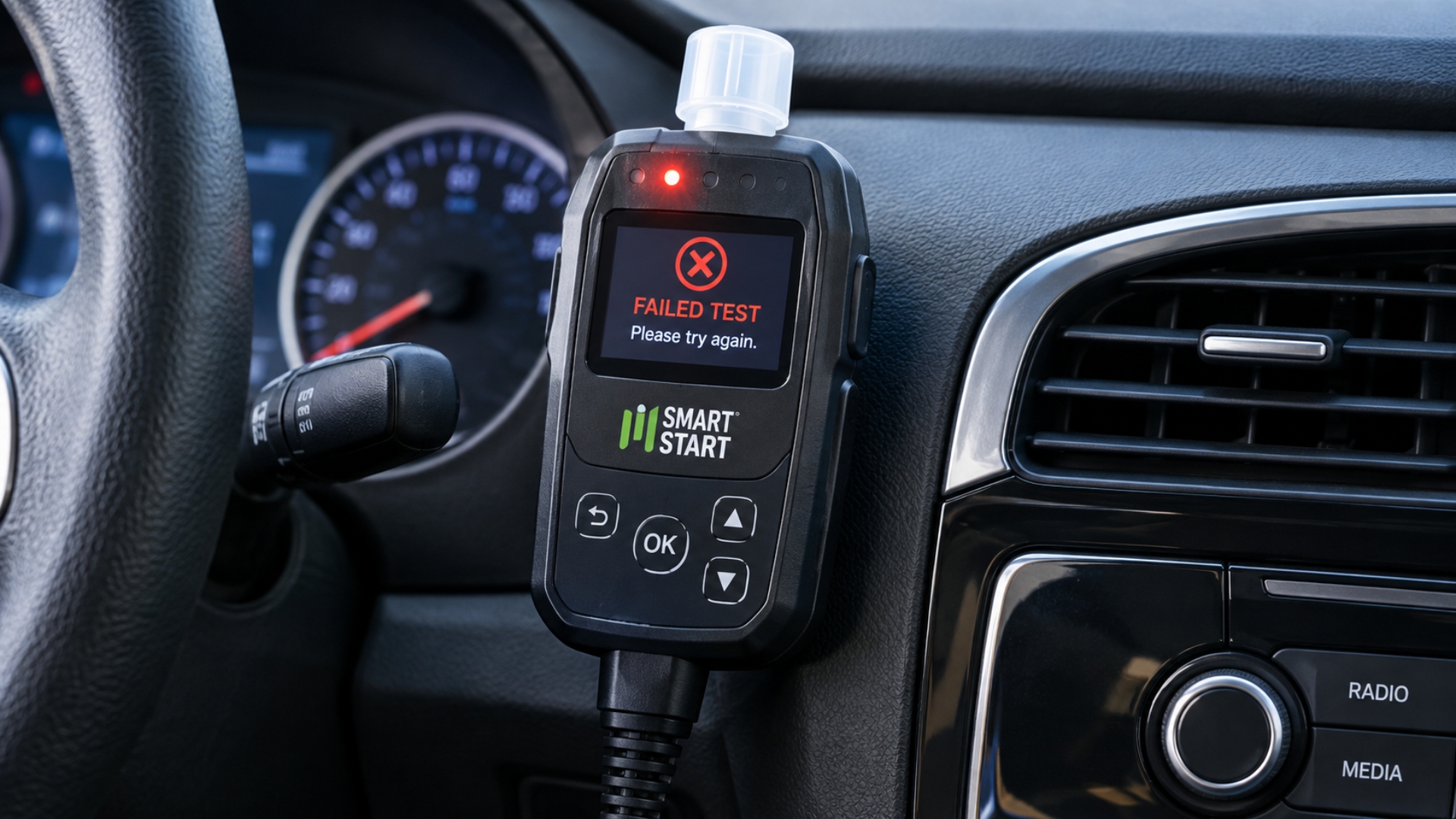
Summary: Understanding the difference between interlock failure vs violation will help you complete your Colorado interlock program successfully. A failure happens when your device detects alcohol and prevents your car from starting, often from mouthwash or hand sanitizer, while a violation is a reportable pattern of non-compliance that can extend your program or result in penalties. At Pit Stop Interlock, we provide the education, support, and reliable Smart Start technology you need to avoid violations and regain your full driving privileges.
What Is an Interlock Failure?
An interlock failure happens when you provide a breath sample that registers alcohol, and your device prevents your vehicle from starting. When this happens, your interlock device is doing exactly what it’s designed to do: keeping you and others safe. Interlock devices are sensitive and can detect alcohol from various sources, not just drinking. Interlocks can be triggered by alcohol-based mouthwash, certain medications, hand sanitizer residue, or even foods prepared with alcohol. If you fail a test, your device records the event, but it doesn’t automatically mean you’re in trouble.
Think of a failure as a data point. Your interlock system is collecting information throughout your program period, and occasional failures can happen for legitimate reasons. You’ll be given another opportunity to provide a clean sample after a short waiting period, usually a few minutes. If you genuinely haven’t been drinking, that second test will likely pass once any residual alcohol from external sources has dissipated. Know that a single failed test isn’t necessarily going to derail your entire program.
What Is an Interlock Violation?
A violation differs from a failure because it reflects a pattern of breaking the rules of your interlock program. Violations get reported, and they can result in serious consequences including lockouts, program extensions, additional fines, or criminal charges. Common violations include multiple failed tests in a short period, attempting to tamper, missing calibration appointments, or failing to provide a rolling retest. Each of these actions suggests either an attempt to circumvent the system or a failure to comply with the program.
Your interlock program has specific thresholds that determine when a failure becomes a violation. For example, if you have several failed tests in a row without passing tests in between, that pattern might trigger a violation report. Similarly, if you fail a rolling retest while driving, it’s even more serious than a failed startup test. A failed rolling retest implies that you are drinking and driving.
Related: What Happens If You Get an Ignition Interlock Lockout? (and How to Fix It)
Interlock Failure vs Violation
The main difference between an interlock failure vs violation comes down to frequency, context, and intent. A failure is an isolated event. Your device detected alcohol and prevented the vehicle from starting. A violation is a reportable incident that suggests non-compliance with your program requirements. You can have failures without violations, but violations often involve multiple failures or other problematic behaviors.
Your monitoring authority understands that life happens and that not every failed test means you’ve been drinking and driving. They’re looking for repeated patterns that indicate you’re attempting to drive under the influence.
What Happens When You Have a Violation
Your interlock program has a set end date, but violations can push it further into the future. Each violation can add weeks or months to your program, which means more time with the device in your vehicle and more monthly fees. When a violation occurs, your interlock provider must report it to the Colorado DMV and your monitoring authority, which may be the court, probation office, or DMV, depending on your specific case.
The consequences depend on the type and severity of the violation, as well as your overall compliance history. For minor violations, you might receive a warning or be required to attend additional education or counseling. More serious violations can result in an extended program, additional fines, or, in severe cases, revocation of your interlock-restricted license. Also know that if you’re caught drinking and driving, you could face new criminal charges.
Read Also: What Happens If You Missed an Interlock Calibration Appointment?
How Pit Stop Interlock Supports You
At Pit Stop Interlock, we understand that navigating the interlock program can feel overwhelming, especially if this is your first DUI conviction. That’s why we’re here to support you every step of the way. We’re a Colorado DMV-approved provider, which means our installations meet all state requirements and our reporting is accurate and timely. Unlike some providers who treat you like just another number, we take time to explain how your device works, what can cause failed tests, and the difference between an interlock failure vs violation.
We offer three convenient locations throughout Colorado Springs: South near Fort Carson, Central on Academy Boulevard with Saturday hours, and East near Powers Boulevard so you’re never far from support when you need it. Our monthly calibration appointments typically take just 10-15 minutes, and we don’t require appointments for these routine services. We know your time is valuable, and we respect that. With us, you get no hidden fees or surprise charges. What we quote is what you pay.
The Smart Start Advantage
We install Smart Start systems, which are reliable and user-friendly. Smart Start devices feature fast warm-up times, so you’re never sitting and waiting before you can take your first test. The Smart Start interface is intuitive and easy to understand, with clear prompts that tell you exactly what to do. Smart Start also offers 24/7 customer service and bilingual support, so if you have questions or concerns at any time, day or night, you can get help.

Interlock Failure vs Violations: Tips to Complete Your Program Successfully
The best way to avoid violations is to treat your interlock program seriously and follow all requirements consistently:
- Always provide breath samples when your device prompts you.
- Never ask someone else to blow into your device.Can mouthwash cause me to fail an interlock test?
- Avoid alcohol completely during your program period.
- Be mindful of products that contain alcohol and can cause false positives.
- Keep your monthly calibration appointments on schedule. If you need to reschedule, do it before your appointment date passes, not after.
If you do fail a test, don’t panic. Wait a few minutes, rinse your mouth with water, and test again. Document any medications you’re taking, just in case you need to explain a failed test. If you continue to have problems, contact us immediately. We can help you troubleshoot and determine whether there’s a problem with your device or something in your routine causing false positives.
You May Also Like: Can Two People with DUIs Share the Same Ignition Interlock Device?
Fully Understand the Difference Between an Interlock Failure vs Violation with Help from Pitstop Interlock
Dealing with a DUI conviction is stressful enough without worrying about every breath test and wondering if you’re going to violate your program accidentally. If you’re required to install a device, you don’t have to navigate this process alone. Pit Stop Interlock provides the reliable, judgment-free support you need to complete your program successfully. Our certified technicians will install your Smart Start device quickly and teach you how to avoid violations and stay in compliance.
Don’t let confusion about failures and violations add unnecessary stress to your life. Reach out to Pitstop Interlock today to schedule your installation appointment. Your journey to unrestricted driving starts here.